Oscar Tuazon
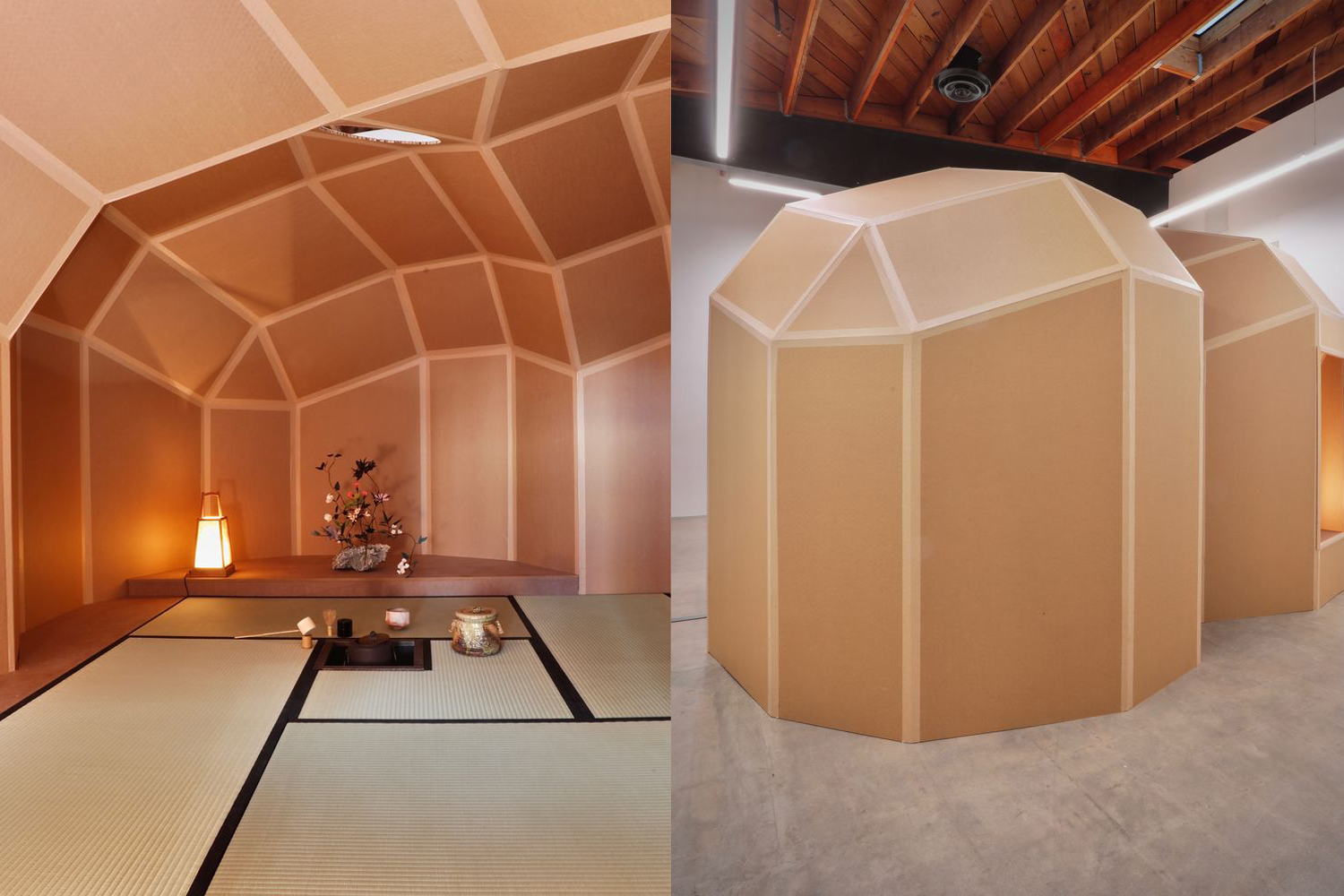
Circle House, 2026 (detail views)
Cardboard, wood, and tatami mats
173 x 175 x 110 inches
(440 x 444.5 x 279.5 cm)
Courtesy of the artist, rocky’s matcha,
and Morán Morán
Photography by Joshua White
Oscar Tuazon Circle House
Oscar Tuazon’s Circle House (2026) extends a practice that has consistently tested the thresholds between sculpture, architecture, and lived environment. Across his career, Tuazon has approached building not as a purely functional discipline nor as a metaphorical device, but as a site of tension: between autonomy and use, between formal rigor and bodily occupation, between conceptual systems and material contingency.
Tuazon’s work has long drawn from structuralism in both its architectural and philosophical dimensions. Structurally, his constructions often foreground load, joinery, and the logic of assembly; beams bear weight visibly, fasteners remain legible, and materials are neither disguised nor subordinated to illusion. Conceptually, this structural exposure aligns with a broader inquiry into systems – how meaning, space, and subjectivity are organized through frameworks that precede individual expression. In Circle House (2026), structure and symbol converge in the figure of three “circles.” Rather than treating these circles as abstract motifs, Tuazon renders them spatially, experiential, and inhabitable.
The work explicitly channels the concept of the ensō, the single-brush circle associated with enlightenment, emptiness, and disciplined spontaneity. The ensō is not simply a shape; it is a record of a moment – gesture made visible, mind made trace. Traditionally, it is executed in one continuous stroke, revealing the state of the artist at the instant of its making. By translating this calligraphic act into architecture, Tuazon performs a significant transformation: the ephemeral mark becomes a durable enclosure; the instantaneous gesture becomes a site of sustained occupation. The circle ceases to be an image and becomes an environment.
This translation recalls the spatial logic of traditional Japanese tea houses, whose architecture is inseparable from ritual, temporality, and philosophical orientation. Emerging from the aesthetics of wabi-sabi and Zen-inflected minimalism, the tea house is deliberately modest. Constructed of natural materials – wood and paper – it privileges tactility and proportion over monumentality. Its entrance encourages guests to pause, symbolically leveling social hierarchies and preparing the body for contemplative presence. The interior is sparse, defined by tatami mats that regulate spatial rhythm and bodily orientation. Every element, from the tokonoma alcove to the kettle’s placement, participates in a choreography of attention.
Tuazon’s Circle House (2026), while conceptually framed, resonates within this lineage. It operates both as a sculptural object to be viewed and as a spatial condition to be entered. The invitation is literal and figurative, as the work proposes a mode of gathering oriented toward reflection and shared time. Commissioned by rocky’s matcha and activated through traditional Japanese tea ceremonies, the installation is both artwork and functional environment. The circular plan destabilizes hierarchies of front and back, dispersing focus evenly and encouraging relational presence. Like the tea house, it frames a shared interior defined less by ornament than by proportion and atmosphere. Emptiness, central to the ensō, is reinterpreted architecturally: the interior void is not absence but potential, a space activated by bodies, ritual, and time.
Dates
February 21 - December 31, 2026Opening Reception
Saturday, February 21, 6-8pmLocation
641 N Western AvenueLos Angeles, CA 90004
Artist
Oscar Tuazon

